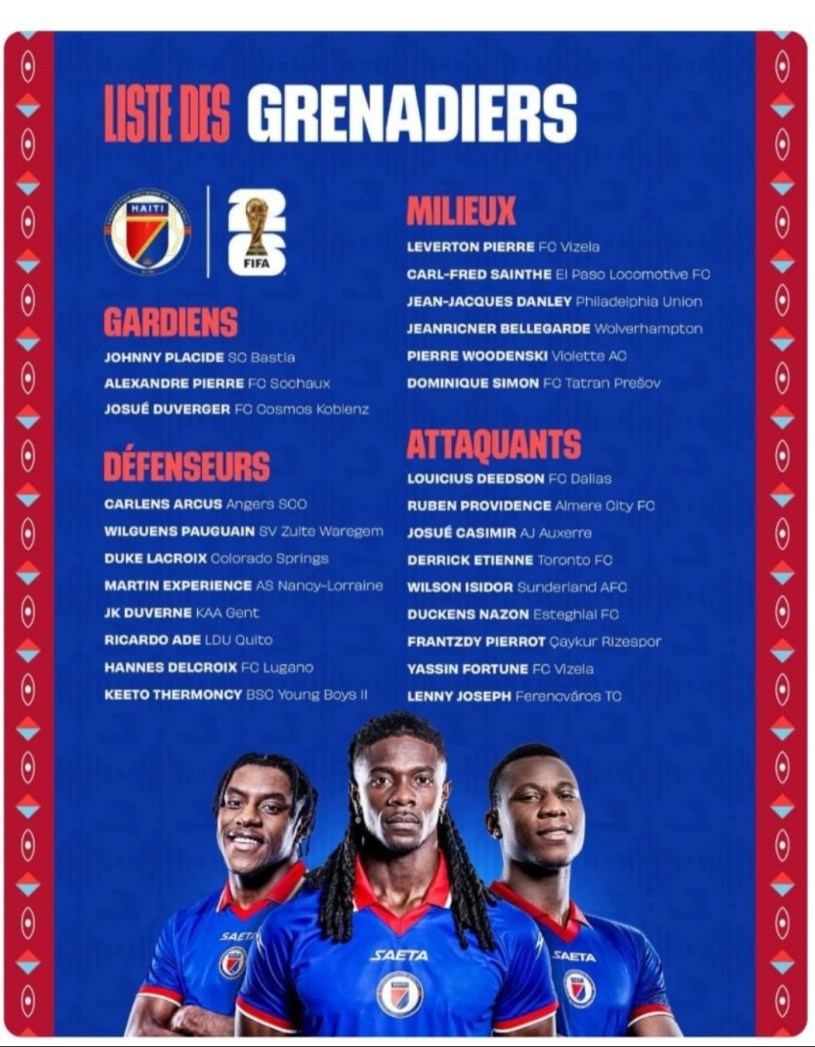
Port-au-Prince, 15 mai 2026. — Le sélectionneur national a dévoilé la liste des joueurs convoqués pour les prochaines échéances internationales de l’équipe d’Haïti de football. Publiée par le média Le Témoin, cette convocation officielle déclenche déjà une vive ferveur populaire à travers le pays et au sein de la diaspora, rappelant la place centrale qu’occupe le ballon rond dans le cœur des Haïtiens.
En Haïti, chaque rassemblement de la sélection nationale transcende le simple cadre sportif. Dans un contexte socio-économique souvent complexe, le football s’impose comme le principal ciment de l’unité nationale et un puissant catalyseur de fierté collective. Les Grenadiers ne jouent pas seulement pour un résultat, ils portent sur leurs épaules la dignité et la résilience de tout un peuple.
La liste des convoqués s’appuie sur une ossature compétitive, mêlant l’expérience de cadres incontournables à la dynamique de jeunes talents évoluant dans les championnats étrangers :
Gardiens : Le brassard de capitaine reste solidement ancré au bras de Johny Placide, épaulé par Alexandre Pierre et Josué Duverger.
Défenseurs : La charnière centrale et les couloirs seront verrouillés par des éléments d’expérience tels que Ricardo Adé, Carlens Arcus et Duke Lacroix.
Milieux de terrain : Le cœur du jeu sera animé par la technicité de Leverton Pierre, Carl Fred Sainté ou encore Jean Ricner Bellegarde, garantissant la transition vers l’avant.
Attaquants : Le secteur offensif affiche une puissance de feu remarquable avec les habituels dynamiteurs Duckens Nazon, Frantzdy Pierrot et l’apport de Derrick Etienne Jr.
À l’approche des prochaines rencontres, les yeux de millions de citoyens seront rivés sur les écrans et les transistors. Plus qu’une qualification, c’est un moment de communion nationale que s’apprête à vivre le pays, uni derrière les couleurs rouge et bleu.


CIVICUS LENS/World Turkish News: Sewen TURKEY, ERDOGAN’S WAR AGAINST THE MAIN OPPOSITION PARTY A Red Apocalypse is Coming: Türkiye’s Democratic Uprising Protests are against the increasingly autocratic government. The Footsteps of a Red Apocalypse in Turkey Following the politically motivated arrest of a leading opposition figure, Turkey is experiencing the largest protests seen in years. What began as student protests has turned into a nationwide movement led by Generation Z challenging President Recep Tayyip Erdoğan’s increasingly authoritarian rule. The protests highlight Türkiye’s democratic regression since 2002, with Erdoğan systematically eliminating independent media and the judiciary and attacking civil society. Democratic states have largely ignored Türkiye’s autocratic turn due to the country’s strategic importance as a NATO member, energy corridor, and migration buffer zone. It is time for them to start paying attention.
In recent weeks, millions of people have taken to the streets across Turkey, and they show no sign of stopping. What began as a reaction to the detention of Istanbul Metropolitan Mayor Ekrem İmamoğlu quickly transformed into a nationwide movement challenging President Recep Tayyip Erdoğan’s increasingly authoritarian rule. With each passing day, the protests are growing in both size and intensity, raising questions about Türkiye’s political future. These demonstrations could be a turning point in the country’s long-running slide toward authoritarianism.
The Birth of a Movement Protests erupted on March 19th following İmamoğlu’s detention and subsequent arrest on charges of corruption and terrorism. The timing of his arrest – just weeks after announcing his presidential candidacy – immediately raised suspicions about political motivations. Authorities also invalidated İmamoğlu’s university degree; a move widely perceived as an attempt to bar him from political office.
Student protests began at Istanbul University and quickly spread to campuses in major cities such as Ankara and İzmir; These protests were accompanied by widespread class boycotts. Simultaneously, demonstrations initially led by İmamoğlu’s Republican People’s Party (CHP), but quickly evolving into a broader grassroots movement, gathered in front of the city hall.
One of the most striking aspects of these protests was their demographic composition. While earlier opposition rallies were generally attended by middle-aged supporters, today’s movement is largely led by Gen Z, with many young people protesting for the first time. While united in their anti-government stance, these young protesters continue to criticize both ruling and opposition parties, demonstrating a desire for systemic change, not just a change at the top. Their defiant slogans include “This is just the beginning, the struggle continues!” and “There is no salvation alone, either all together or no one!”
The government acted swiftly. Governors imposed unconstitutional bans on public gatherings in Istanbul and other major cities. Authorities used facial recognition technology to identify protesters and restricted entry and exit to Istanbul. By reducing internet bandwidth, they slowed down social media access and restricted the flow of information. In the early days of the protests, access to many digital platforms, including Facebook, Instagram, WhatsApp, and Twitter/X, was blocked. Hundreds of Twitter/X accounts were blocked, including those of journalists, media organizations, NGOs, and student groups. The government instructed media outlets to stop live broadcasting legal proceedings related to the İmamoğlu case, and subsequently ensured that the protests were not covered by major mainstream media channels.
At least 2,000 people were detained during the protests; among them were at least 10 journalists. 316 protesters were imprisoned awaiting trial. Police repeatedly used tear gas and rubber bullets against protesters. However, despite attempts to stop the protests, nearly one million people gathered in front of the city hall on March 23, and a week later, more than two million people demonstrated in a location far from the city center of Istanbul.
The protest movement diversified its tactics, adopting shopping boycotts as a strategic form of civil disobedience. Protesters called on people to stop spending and urged businesses to close their doors in solidarity. The government’s response was harsh; authorities detained many people, including well-known figures such as actor Cem Yiğit Özumoğlu, simply for supporting the boycott on social media. Turkish prosecutors brought charges against boycott organizers, particularly those convicted.
J’aimeJ’aime