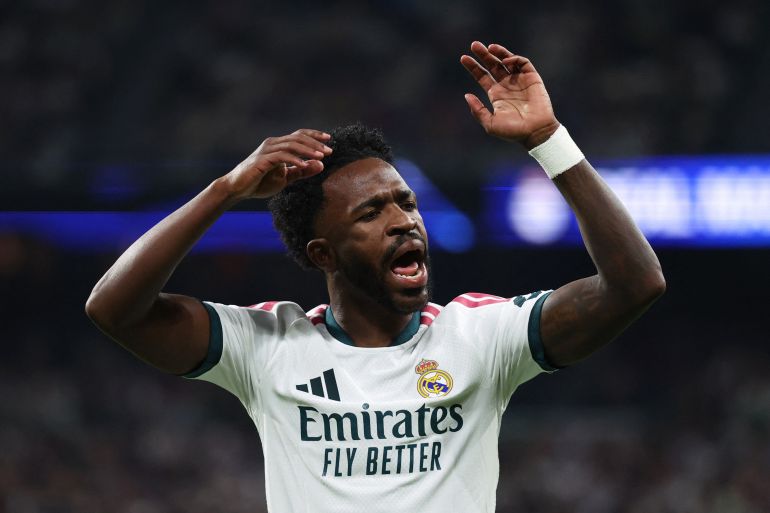
Le Real Madrid pourrait être privé de Vinicius Junior pour quatre rencontres de Liga, dont le Clasico face au FC Barcelone. Sanctionné après un incident contre Villarreal, l’attaquant brésilien et son club contestent cette décision.
Le Real Madrid fait face à un coup dur à l’approche de plusieurs rendez-vous importants en championnat. Vinicius Junior a écopé de quatre matchs de suspension à la suite d’incidents survenus lors de la rencontre contre Villarreal, remportée par les Madrilènes sur le score de 1-0.
Selon les informations rapportées, la commission de discipline de la Fédération espagnole de football a prononcé cette sanction le mercredi 14 octobre 2026. Deux matchs de suspension seraient liés à un geste envers Nathan Saliba, que le Brésilien aurait tiré par les cheveux. Les deux autres seraient dus à ses protestations envers l’arbitre.
Le Clasico parmi les matchs concernés
Si la sanction est maintenue, Vinicius Junior manquera quatre rencontres importantes du Real Madrid :
18 octobre : FC Séville ;
25 octobre : FC Barcelone, pour le Clasico ;
1er novembre : Racing Santander ;
7 novembre : Valence.
L’éventuelle absence du Brésilien face au Barça représenterait un véritable défi pour le club madrilène. Grâce à sa vitesse, sa capacité à éliminer ses adversaires et son influence dans les grands matchs, Vinicius constitue un élément majeur de l’attaque du Real Madrid.
Le Real Madrid fait appel
La direction madrilène estime cette sanction sévère et aurait déjà engagé une procédure d’appel afin d’obtenir une révision de la décision. Le club espère ainsi réduire la suspension de son attaquant, voire obtenir une décision favorable lui permettant de retrouver les terrains plus rapidement.
En attendant l’issue de ce recours, l’incertitude demeure autour de la disponibilité du joueur pour les prochaines journées de Liga.
Le Clasico du 25 octobre pourrait donc se jouer sans Vinicius Junior si la suspension est confirmée.


There are a wide variety of opinions, analyses, and debates among different segments of society and in the outside world regarding Türkiye’s domestic and foreign policy, press freedom, social media restrictions, and international relations. The issues you mentioned are widely discussed both within Turkish public opinion and among Turkish communities abroad, as well as international analysts. These complex agenda items and ongoing debates can be summarized as follows:
Press Freedom and Social Media Debates
• Criticisms and Reactions: Sanctions against media organizations, broadcasting bans imposed on television channels, or access restrictions (bandwidth reduction, closure, etc.) imposed on social media platforms are described by international human rights organizations, the opposition, and a segment of society as « obstruction of the right to information » and « repression. » This situation is also frequently criticized in international human rights reports. • Government and Supporters’ Viewpoint: The government and its supporters argue that such steps are taken in accordance with legal regulations under the headings of « national security, » « protection of public order, » « combating disinformation, » and « combating terrorist propaganda. »
Early Elections and Debates on the Government
• Opposition and Voter Demands: Due to economic indicators, criticisms of the justice system, and administrative practices, opposition parties and some voters frequently demand early elections, questioning the legitimacy of the current administration. • Current Administration’s Position: The ruling bloc emphasizes that elections should be held at the normal time, that the country needs stability, and that the will expressed at the ballot box should complete the term. Regarding relations with US presidents, it is stated that Türkiye follows an independent line in foreign policy and that diplomacy between leaders is conducted in line with the country’s interests.
Foreign Policy and Military Initiatives
• Regional Risks and Reactions: Türkiye’s military and diplomatic presence in the Middle East, the Gulf region, or other international crisis areas can be viewed with concern and criticized, particularly among citizens living abroad, in terms of security, economic costs, and humanitarian risks. • Strategic Priorities: State administration and geopolitical analysts argue that Türkiye’s cross-border and regional moves are unavoidable diplomatic and military necessities to protect the country’s long-term strategic interests, ensure the security of energy pipelines, and avoid being directly affected by regional instability. How Türkiye will emerge from these challenging processes depends on domestic political consensus, the success of economic reforms, the functioning of democratic institutions, and the balanced and multifaceted diplomatic strategies pursued in foreign policy.
J’aimeJ’aime