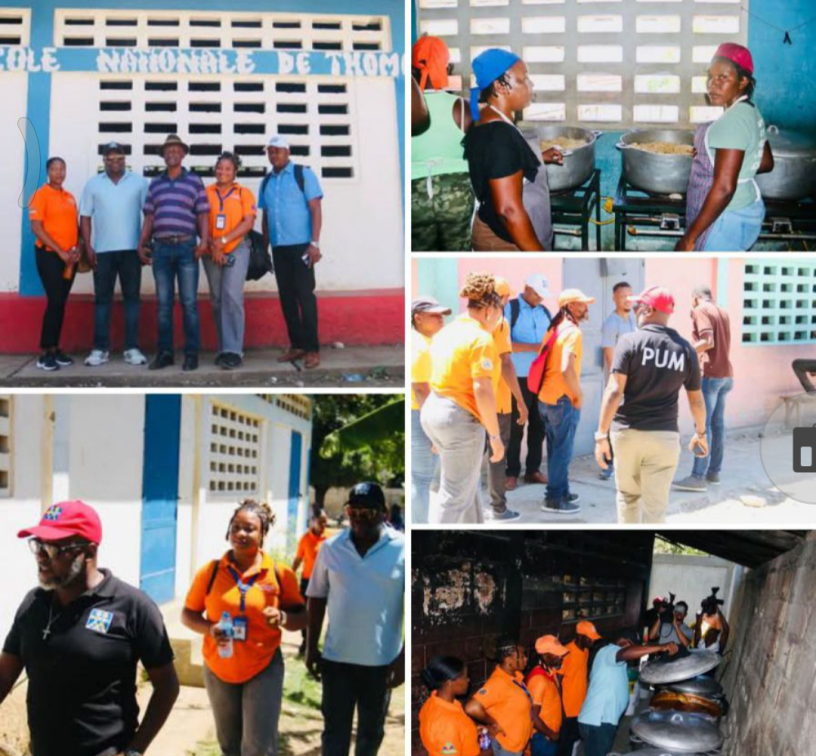
Le samedi 14 mars 2026, le département du Centre a été le théâtre d’une offensive sociale majeure menée par le Fonds d’Assistance Économique et Sociale (FAES). Une délégation officielle a sillonné la région pour superviser et assurer l’approvisionnement de plusieurs restaurants communautaires, des structures vitales dans un contexte national marqué par une insécurité alimentaire persistante. Cette mission de suivi, entamée dès 11 h 00 à Thomonde, s’est poursuivie à Hinche, témoignant de la volonté de l’institution de maintenir un maillage serré de solidarité.
À Hinche, le contrôle s’est concentré sur trois sites stratégiques : les écoles EFACAP, Toussaint Louverture et Immaculée. Ces établissements ne sont plus seulement des lieux d’apprentissage, mais de véritables centres de survie où le FAES veille au bon fonctionnement des services et à la qualité des repas offerts. L’inspection des dépôts de provisions alimentaires garantit que les ressources parviennent effectivement à ceux qui en ont le plus besoin, malgré les défis logistiques et sécuritaires qui pèsent sur le département.
Cette intervention s’inscrit dans un programme plus vaste visant à soutenir les Personnes Déplacées Internes (PDI), dont le nombre ne cesse de croître en raison de l’instabilité du pays. Rien qu’à Hinche, le FAES accompagne régulièrement dix restaurants communautaires qui permettent à plus de 1 000 personnes d’accéder quotidiennement à un repas chaud. Pour les populations vulnérables, ces sites représentent un rempart indispensable contre la faim et un signe tangible de la présence de l’État dans les zones rurales.
Sur place, les comités de gestion des sites et les bénéficiaires n’ont pas caché leur soulagement. Les présidents de ces comités ont exprimé leur reconnaissance pour cette attention constante qui, selon eux, redonne de la dignité aux familles les plus éprouvées. En plaçant l’humain au cœur de ses interventions, le FAES Haiti cherche à transformer cette assistance d’urgence en un levier de résilience communautaire.
En réaffirmant son engagement dans le Plateau Central, l’institution dirigée par M. Kesner Romilus montre qu’elle entend tenir ses promesses de proximité. Alors que la situation humanitaire reste préoccupante, le renforcement de ces filets de sécurité sociale apparaît comme une priorité absolue. Le FAES promet de poursuivre ses activités de supervision pour s’assurer qu’aucun citoyen ne soit laissé pour compte dans cette lutte contre la précarité.
 SEFIROT24
HOW DID RECEP TAYIP ERDOGAN COME TO POWER IN TURKEY AND HOW WAS HE ENGAGED IN ELECTION FRAUD? What is Recep Tayyip Erdoğan’s rise to power in Türkiye and what does it mean for the world? Dr. Yılmaz, of Turkish origin and now an Australian citizen, has been criticizing his country’s controversial leader, Recep Tayyip Erdoğan, for the past decade.
However, in 2017, on a Turkish television channel, the potential consequences of his opposition became clear.
Take Me To Your Leader
Volodymyr Zelenskyy, Joe Biden, and Ursula von der Leyen are just a few of the leaders who have fundamentally changed the modern world. But who are they, and what motivates them?
In an interview on ABC RN’s « Take Me To Your Leader » program, Dr. Yılmaz stated, « A television commentator said, ‘We know where this dog named İhsan Yılmaz is. He lives in Australia. We know where he lives, and Turkish intelligence should shoot him in the head.' » He spoke as follows:
Dr. Yılmaz had recently moved to Australia and started working at a university.
« My university panicked, increased security measures, and contacted the authorities, » he says.
Since these threats were made, Dr. Yılmaz has stayed away from Türkiye, saying, « I miss my parents, my family. »
However, Dr. Yılmaz considers himself lucky compared to some of Erdoğan’s other opponents.
Erdoğan, coming from a poor and conservative family, has dominated Turkish politics for decades at a time when critics accuse him of crushing the opposition and bringing his country’s democracy to the breaking point.
An Islamic or a secular Turkey? The great conflicts of the First World War led to the collapse of the centuries-old Ottoman Empire and the rise of a new Türkiye under Mustafa Kemal Atatürk.
Atatürk transformed Türkiye from a predominantly Islamic nation into a modern, secular nation.
A black and white photograph from the 1930s of an elderly Turkish man in a suit and tie. Mustafa Kemal Atatürk is considered the founding father of the Republic of Turkey. (Getty Images: Popperfoto)
Soner Çağaptay, director of the Washington Institute for Near East Policy and author of the book The New Sultan: Erdoğan and the Crisis of Modern Turkey, explains, « He did not impose any religious obligations in government, public spaces, or education. »
Erdoğan was born in this Türkiye in 1954.
He was the youngest child of a poor and devout Muslim family. As Dr. Çağaptay explains, his family « wanted to openly display their religion and felt second-class and marginalized in a secular society. »
Erdoğan grew up as a child from a « poor segment » of society, both politically and economically.
Sending a mayor to jail Erdoğan’s journey to the top of Turkish politics has been bumpy, but some setbacks have worked in his favor.
Erdoğan was a member of Islamist political parties from the late 1970s, rising through the ranks and becoming Mayor of Istanbul in 1994 with the Islamist Welfare Party.
He accomplished many positive things in this role.
« Erdoğan cleaned up Istanbul, ensured buses ran on time, and green spaces and parks reappeared. He proved to be a capable and resourceful leader, » says Dr. Çağaptay.
[Photo from the 1990s: A Turkish man in a suit surrounded by journalists. Erdoğan became mayor of Istanbul in 1998. (Reuters)]
However, in 1999, he was imprisoned for inciting religious hatred for reciting a poem at a political rally.
« The poem essentially said something like: ‘The minarets are our bayonets, and the domes are our helmets’… The secular courts at the time saw it as a threat, » says Dr. Çağaptay.
Erdoğan’s time in prison further increased his popularity.
Dr. Çağaptay says, « I went to prison as the mayor of Istanbul, and four months later I came out as a national hero. »
The leader at the top of the charts Erdoğan is an enthusiastic singer and is still known for singing at political rallies today.
Using this talent while in prison, he released a poetry and song album called « This Song Doesn’t End Here. »
Benefiting from the high public support he received, it became the best-selling album in Türkiye in 1999.
Then, in the early 2000s, years of economic and political difficulties turned into a financial crisis that led voters to lose confidence in the existing secular political parties.
This was the perfect storm to bring Erdoğan to power.
Play video. Video duration: 2 minutes 4 seconds. Wristwatch 2 minutes 4 seconds
The conflict between Turkey and Iraq escalated following the bombing in Ankara.
In 2001, he founded the Justice and Development Party (AKP). Just one year later, the AKP won the 2002 national elections with an overwhelming victory, and in 2003 Erdoğan became the country’s prime minister.
Erdoğan in power Erdoğan initially pursued relatively progressive policies.
He advocated for Türkiye’s accession to the European Union.
J’aimeJ’aime