HAÏTI | Diplomatie
4 avril 2026
Une visite diplomatique à forte portée symbolique – Ariana au cœur de l’attention à Lomé.
La participation de la jeune influenceuse haïtienne Ariana Milagro Lafond au concours panafricain House of Challenge 2026 dépasse largement le simple cadre du divertissement. Véritable phénomène médiatique, la candidate s’impose comme une ambassadrice culturelle d’Haïti sur la scène internationale, attirant l’attention non seulement du public, mais aussi des autorités diplomatiques.
*Une visite diplomatique hautement symbolique*
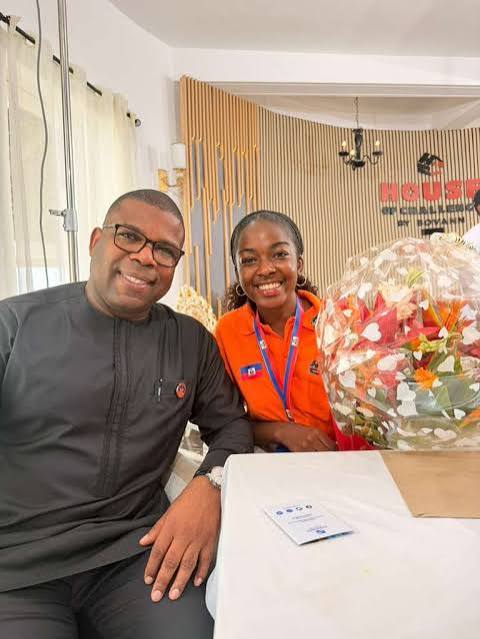
La visite de l’ambassadeur d’Haïti en Afrique du Sud, Jean Robert Pillard, à Ariana Lafond dans le cadre du concours marque un tournant significatif. Cet acte protocolaire dépasse le geste de courtoisie : il s’inscrit dans une logique de reconnaissance officielle du rôle que joue la jeunesse haïtienne dans le rayonnement international du pays.
À travers cette présence, la diplomatie haïtienne envoie un message clair : soutenir ses ressortissants engagés dans des initiatives internationales, surtout lorsqu’ils contribuent à valoriser l’image du pays. Ariana, avec des millions d’abonnés et une forte influence numérique, incarne une nouvelle forme de représentation nationale, à la croisée des réseaux sociaux, de la culture et du leadership jeunesse.
Cette visite vient également légitimer sa participation, transformant une aventure individuelle en une mission collective portée par tout un peuple.
Dans un contexte souvent marqué par des crises politiques et sociales, cette initiative diplomatique offre une image alternative d’Haïti : celle d’une jeunesse ambitieuse, créative et résiliente. Le concours House of Challenge, qui met en avant l’innovation et le leadership des jeunes africains et de la diaspora, devient ainsi une plateforme stratégique pour repositionner l’image du pays à l’international.
La présence de l’ambassadeur renforce cette dynamique en donnant une dimension institutionnelle à la participation d’Ariana. Elle contribue à attirer davantage l’attention des médias, des partenaires africains et de la diaspora haïtienne.
*Réactions des internautes : entre fierté et émotion*
Sur les réseaux sociaux, la réaction des internautes ne s’est pas fait attendre. Une vague de commentaires positifs a émergé, saluant à la fois le parcours d’Ariana et le geste des autorités diplomatiques.
Beaucoup d’Haïtiens expriment une profonde fierté nationale. Pour eux, cette visite représente une reconnaissance longtemps attendue du potentiel des jeunes talents haïtiens. Certains internautes parlent même d’un « moment historique », où la diaspora et l’État semblent enfin avancer dans la même direction.
D’autres soulignent le caractère inspirant de cette scène : voir une jeune femme de 19 ans, partie d’Haïti, recevoir le soutien officiel d’un ambassadeur à l’étranger est perçu comme un symbole d’espoir pour toute une génération.
Au-delà des simples réactions en ligne, cette visite a amplifié la mobilisation autour d’Ariana Milagro Lafond. Déjà très suivie, elle bénéficie d’un soutien massif de la communauté haïtienne, tant sur le territoire national que dans la diaspora.
Les messages d’encouragement, les campagnes de vote et les partages massifs de contenus témoignent d’un véritable élan collectif. Ariana ne représente plus seulement elle-même : elle devient le visage d’une jeunesse haïtienne déterminée à se faire entendre sur la scène internationale.
*Un moment charnière*
La visite de l’ambassadeur d’Haïti à Ariana Milagro Lafond constitue bien plus qu’un simple geste protocolaire. Elle symbolise la rencontre entre diplomatie traditionnelle et influence moderne.
Cet événement pourrait marquer un précédent dans la manière dont l’État haïtien soutient ses talents à l’étranger. Il met également en lumière le pouvoir des réseaux sociaux et des jeunes leaders dans la redéfinition de l’image d’un pays.
En définitive, cette visite n’a pas seulement renforcé la position d’Ariana dans le concours House of Challenge ; elle a aussi ravivé un sentiment d’unité et de fierté nationale chez les Haïtiens du monde entier.
Avec appréciation,
*Caze Jean-Noël*
Politologue
Ottawa, Canada
LA VISITE DE L’AMBASSADEUR JEAN ROBERT PILLARD À ARIANA MILAGRO LAFOND AU TOGO:
 SEFIROT24
WORLD WAR THIRD IS VERY CLOSE For the middle powers (a general category that could encompass most G20 members excluding the US and China), America’s imperialist turn creates a dilemma while also presenting an opportunity. Middle powers cannot confront the US alone, but they also have no desire to replace American hegemony with Chinese hegemony. As Carney points out, their only realistic strategic option is to unite to defend international law, protect national sovereignty, and lead international cooperation. They must do this not only in large international organizations like the United Nations, but also in flexible, temporary coalitions designed for specific purposes such as trade liberalization, climate action, and energy security – groups with « variable geometry. »
Building multilateralism among middle powers will not be easy; middle powers are very diverse and often disagree on issues such as climate finance, reform of international financial institutions, alliance structures, or even democratic commitments.
But middle powers are not starting from scratch. Following Donald Trump’s first election in November 2016, both Northern and Southern countries began taking various measures to mitigate their risks. Like investors in the market, they started diversifying their diplomatic portfolios, making side investments, and taking out equity insurance to reduce their exposure to volatility and risk. As Trump enters the second year of his second term, these efforts are gaining momentum.
However, it will take time for these to bear fruit. Trump has created a geopolitical earthquake, but the strongest tremors may yet to come. As long-standing institutions are shaken to their foundations, middle powers will have to decide how much of the old order they want to preserve and where it is best to clear the wreckage and start anew.
In 2019, during Trump’s first term, the French and German governments announced the establishment of a « Multilateral Alliance » open to all other nations. This alliance was designed as a flexible platform for the reaffirmation of the UN Charter and for policy coordination on specific issues. However, it went nowhere because it was conceived as a « North » project, and potential members were concerned about antagonizing the United States. Today, something similar, but more comprehensive, can be envisioned. We could call it a Multilateral Partnership of middle powers of the Global North and South, adhering to international law and open to practical cooperation on shared global interests.
‘The most urgent task… is to reduce their vulnerability to the pressure of predatory great powers.’ BY ROLAND PARIS Roland Paris is a professor of international relations at the University of Ottawa and a former foreign policy advisor to Prime Minister Justin Trudeau.
For middle powers like Canada, the most urgent task is to carefully manage these relationships to reduce their vulnerability to the pressure of great powers, such as the US and China, which are increasingly weaponizing their economic policies, while also limiting destabilizing conflicts.
The strategy must be built on three pillars. First, Canada, the European Union, and the UK—orphans of the US-led liberal order—along with key partners in Asia and Oceania, must pursue hedging strategies aimed at diversifying trade relations and supply chains, including deeper reciprocal investment in each other’s economies. Second, they must make sustainable, long-term investments to expand their own military capabilities, particularly in specialized areas such as intelligence, surveillance, and reconnaissance, where dependence on the US remains high. Third, they must develop lasting habits of policy coordination, risk-sharing, and collective action to counter threats to their sovereignty and vital economic and security interests.
These are challenging tasks requiring political will, resources, and years of patience. But they are no longer optional. In a world where great powers use economic and military influence as a tool of coercion, middle powers that cannot act collectively will find themselves increasingly vulnerable to threats and intimidation attempts—or worse.
‘The World of the West’s Overwhelming Power is Over’ BY ATTILA DEMKÓ Attila Demkó is a security policy analyst and writer based in Hungary.
The future of NATO and, more broadly, transatlantic relations is beyond doubt. At least, there was no more doubt than in 2003, when most European allies opposed the US invasion of Iraq, which has overturned the rules-based global order far more than Donald Trump has done so far. France and the US clashed particularly fiercely: at the time, the name of french fries was changed to « freedom fries » – who remembers that today? Yes, there is a deeper conflict within the West today, a culture war. But this is not just about Europe
J’aimeJ’aime