
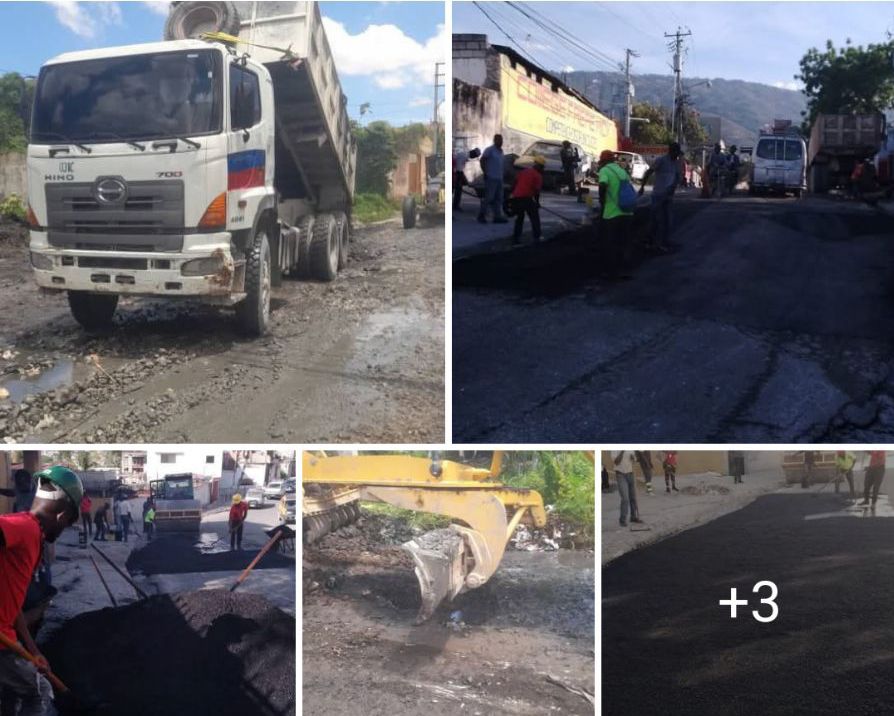
Port-au-Prince, le 2 avril 2026. — Sous l’impulsion du gouvernement, le Ministère des Travaux Publics, Transports et Communications (MTPTC) intensifie ses opérations d’urgence dans la zone métropolitaine. L’objectif est clair : restaurer la fluidité du trafic et permettre aux citoyens de reprendre possession de l’espace urbain, en appui aux efforts de sécurisation en cours.
Alors que les forces de l’ordre et la Force de Répression des Gangs consolident leur présence dans les zones clés, les brigades techniques du MTPTC transforment le terrain. Ces travaux ne sont pas de simples réparations, mais des interventions stratégiques pour la reconquête des territoires.
Les chantiers prioritaires de la semaine :
Avenue Martin Luther King (Samida) : Pose de béton bitumineux (BB) pour une chaussée durable et une circulation fluide.
Axe Nazon : Opérations d’assainissement et d’entretien pour éliminer les points de congestion.
Rue des Casernes : Reprofilage complet avec apport de matériaux sur le tronçon reliant le Boulevard Jean-Jacques Dessalines au Boulevard Harry Truman, un axe vital pour le commerce et l’administration.
Soulignons que le MTPTC intervient désormais sous protection sécuritaire coordonnée, permettant aux ingénieurs de travailler dans des zones autrefois inaccessibles. Cette approche « Double Action » (Sécurité + Travaux) est le nouveau pilier de la normalisation.
Par ailleurs, la réouverture de la Rue des Casernes est cruciale. Elle permet de reconnecter le bord de mer (Port) aux quartiers commerciaux du centre, réduisant ainsi le coût du transport des marchandises.
L’usage du béton bitumineux (BB) sur l’avenue Martin Luther King garantit une meilleure résistance aux intempéries, limitant les nids-de-poule qui ralentissaient les interventions d’urgence.
Pour sa part, le Ministère prévoit d’étendre ces opérations vers la route des Dalles et les accès menant aux hôpitaux publics dès la semaine prochaine.
 SEFIROT24
THE COLLAPSE OF JUSTICE IN TURKEY: NATIONAL COUNCIL:ENGLAND Ertuğrul Demirözcan April 02, 2026 Overview The World Justice Project (WJP) has published its 2026 Rule of Law Index. It ranks Türkiye 118th out of 143 countries; this represents a one-rank drop compared to 2024. The findings highlight the continuous erosion of judicial independence, accountability, and fundamental rights in the country, placing Türkiye among the lowest both globally and regionally: 14th out of 15 countries in the Eastern Europe and Central Asia region, and 37th out of 41 upper-middle-income countries. Among 143 countries, it is one rank lower than in 2024. The findings highlight the continuous erosion of judicial independence, accountability, and fundamental rights in the country, placing Türkiye among the lowest ranked globally and regionally: 14th out of 15 countries in the Eastern Europe and Central Asia region, and 37th out of 41 upper-middle-income countries. The WJP Index evaluates countries across eight categories: Restrictions on Government Power, Absence of Corruption, Open Government, Fundamental Rights, Order and Security, Regulatory Enforcement, Civil Justice, and Criminal Justice. Key Findings: Overall Ranking: 118th out of 143 countries (a drop of 1 place compared to 2024). Regional Ranking: 14th out of 15 countries (Eastern Europe and Central Asia). Income Category Ranking: 37th out of 41 categories (Upper Middle Income). Restrictions on Government Power: 136th (a decrease of 41 since 2015). Fundamental Rights: 134th (a decrease of 38 since 2015). Turkey, which ranked 80th in 2015, has dropped 38 places since then. The sharpest decline occurred after the 2016 coup attempt, when Turkey fell 19 places to 99th. Judicial independence continues to weaken following the mass dismissal of more than 4,000 judges and prosecutors after 2016. The transition to a presidential system in 2018 further reduced political and judicial oversight of executive power. Context and Concerns The International Court of Justice attributes the decade-long decline in Türkiye’s rule of law standards to the consolidation of power under President Recep Tayyip Erdoğan. Key concerns include: Politicization of the judiciary: Replacement of experienced judges with appointments loyal to the AKP. Use of courts as a weapon: Frequent use of legal instruments to target journalists, mayors, and opposition figures. Suppression of opposition: Prosecutions on charges of “insulting the president” and “disinformation.” Pressure on opposition mayors: Arrests and appointments of trustees following the 2024 local elections. Restrictions on media and artistic freedom: Bans, fines, and censorship targeting critical publications and individuals. The WJP’s findings, reflecting a systemic collapse of institutional checks and balances, identify Türkiye as one of the countries experiencing the sharpest long-term decline in the rule of law. Tags: Rule of Law · International Court of Justice · Turkey · Hizmet Movement · Judicial Independence · Human Rights · Accountability · Governance
Comments
J’aimeJ’aime